
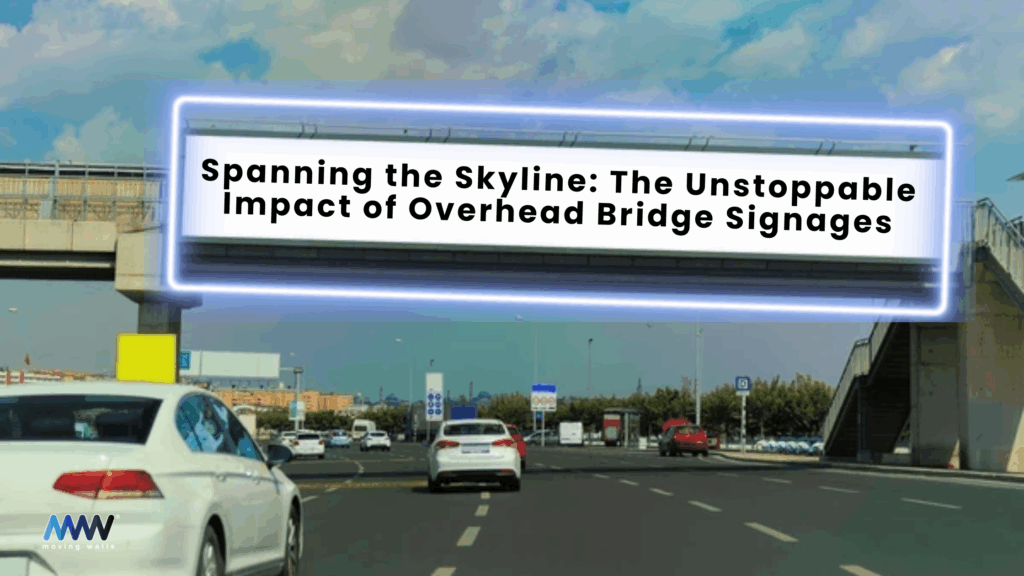
Overhead bridge signages deliver high-impact DOOH impressions at scale from the moment they’re seen. They also offer a clear path to automated, data-driven media buying not just static placement.
Unlike traditional roadside media, overhead bridges are digital screens mounted on full-width highway structures, physically spanning the carriageway and visible to all approaching lanes. Standard gantries, by contrast, are support frames designed primarily for traffic signage with optional ads mounted above roadways but typically limited in width, weight tolerance, and pixel resolution, which constrains both creative scope and audience impact.
Technical Distinctions: Standard Gantries vs Overhead Bridges
Standard Gantries (Traffic Frames):
- Structural design optimized for variable message signs and road management systems.
- Limited mounting width and load tolerance; often restricted to smaller LED panel arrays.
- Primarily serve regulatory and informational functions with advertising as an auxiliary option.
Overhead Bridges (Digital DOOH Platforms):
- Engineered to support wide-span LED screens with high pixel density and brightness.
- Designed for creative heavy formats, longer viewing windows, and clearer line-of-sight.
- Optimised for safety-compliant installation over multiple traffic lanes.
These distinctions matter because technical display capabilities directly influence both creative effectiveness and audience engagement outcomes.
Cost-Efficiency Reality: High Entry, High Reward
Overhead bridge signages typically involve higher upfront fees due to infrastructure, brightness ratings, and structural requirements. But when evaluated on cost per measurable impact — especially with programmatic activation — they can outperform many traditional DOOH buys:
Programmatic buys optimise spend: You pay only when pre-defined delivery conditions are met.
Real-world metrics reduce waste: CPM and impression pacing are driven by data, not estimates.
This shifts the conversation from cost of placement to cost of outcome, aligning spend with measurable value.
Solving Inventory Fragmentation: How Moving Walls Unifies Bridge Media
One of the biggest barriers in DOOH has been fragmented inventory ownership — bridges owned by different operators, each with its own booking system and manual processes.
Moving Walls solves this through:
- A unified Supply-Side Platform (SSP) and inventory registry that consolidates disparate screens under one system.
- Integrated APIs with major Demand-Side Platforms (DSPs) so advertisers can plan and buy bridge inventory programmatically without jumping between portals.
- Real-time proof-of-play and automated scheduling that eliminates manual reconciliation and speeds deployment.
- This approach turns a historically fragmented market into a seamlessly accessible programmatic supply stream.
How to Buy Bridge Inventory Programmatically (Advanced Tactical Guide)
1. Define Delivery Rules, Not Just Screens
Set campaign triggers such as daypart, weather, or traffic flows at the outset then let automation execute your strategy.
2. Use Audience Signals Instead of Geographic Assumptions
Rather than selecting bridge locations by gut or reach alone, choose placements based on aggregated movement data and demographic signals that match your audience profile.
3. Optimise CPM Through Real-Time Bidding (RTB)
Programmatic pathways expose bridge inventory to live auctions; you only serve your ad when your bid conditions are met, which can lower wasted spend over fixed buys.
4. Leverage Attribution Metrics
Track actual outcomes proof-of-play, footfall uplift, and campaign pacing to refine future buys instead of budgeting on estimates.
The Bottomline:
Overhead bridge signages are no longer just a large-format DOOH placement. They are a data-driven, programmatically accessible media channel. Mastering their purchase through automated systems, unified inventory, and real-time analytics is now essential for advertisers seeking measurable impact and efficiency. With the right tools and strategy, bridges can shift from costly line items to predictable performance drivers.
Explore the various media formats used in DOOH advertising.